



The Anderson Platoon and the Living Room War
Will the soldiers survive the brutal realities of war and return home safely?
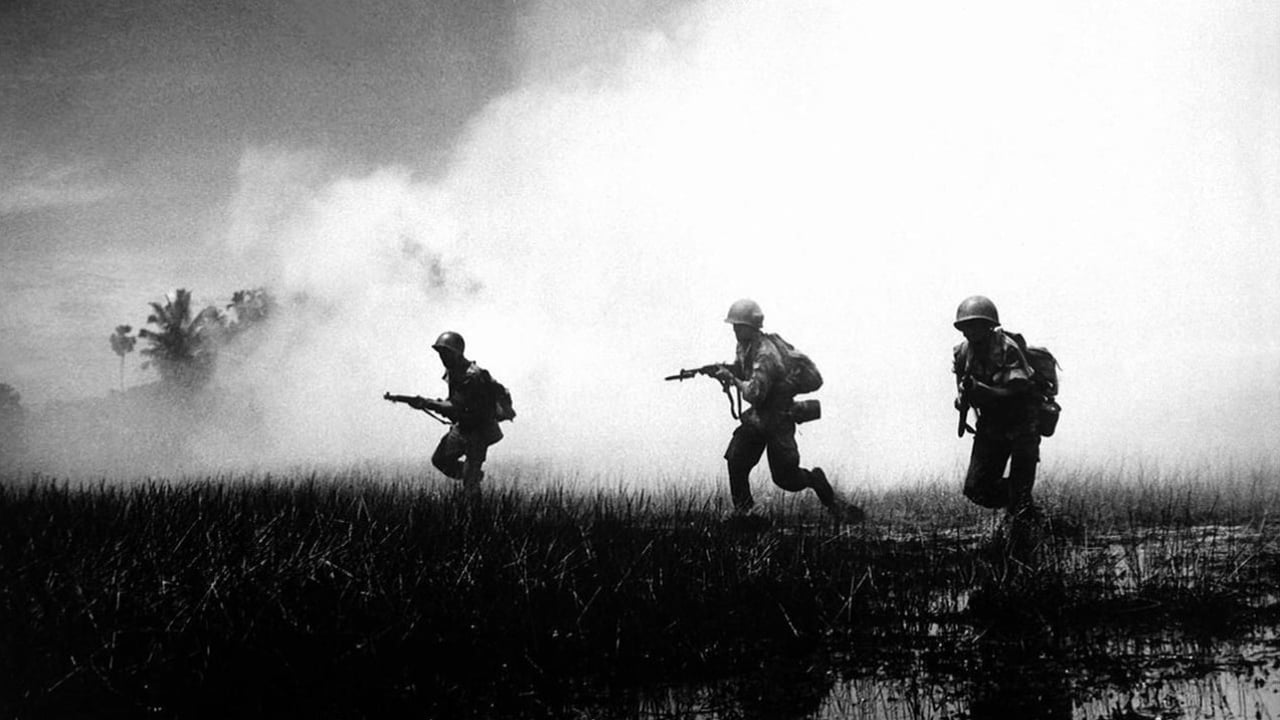
The Anderson Platoon and the Living Room War takes viewers into the Vietnam War alongside Lieutenant Anderson and the men under his command, capturing the conflict as a lived, day-to-day ordeal rather than an abstract headline. In this living room war, the camera stays close to the soldiers’ faces and routines, revealing how fear, exhaustion, and dark humor coexist as they move through a landscape that feels like pure chaos. Told from the platoon’s perspective, the film follows them in a linear stretch of time, charting patrols, conversations, and moments of uneasy quiet that can break without warning into violence.
As the days unfold, camaraderie becomes both refuge and necessity. The men come from different backgrounds, yet the jungle’s constant threat forges a brotherhood that feels unbreakable even as it is tested. Combat is not presented as spectacle; it is confusion, noise, and sudden loss, with the environment itself pressing in as a symbol of danger and disorientation. Moral dilemmas surface in the midst of survival, especially when the platoon encounters a wounded little girl, a haunting reminder of innocence caught in the crossfire and the civilian cost of military decisions.
A devastating ambush and the escalation toward a major battle push the central question to the forefront: will these soldiers endure the overwhelming enemy fire and make it home? The climax confronts them with the brutal arithmetic of war, and the aftermath lingers on emotional toll rather than triumph, reflecting on grief, shock, and the futility that can follow even the act of staying alive. By grounding the Vietnam experience in intimate observation, the film turns the living room war into an urgent human story—watch and witness what survival, loss, and brotherhood look like up close.
In 1966–1967, the United States escalated the Vietnam War amid Cold War fears, rising troop levels, and mounting casualties. Lightweight cameras and relatively open press access brought frontline combat into American living rooms, fueling the credibility gap and growing public doubt before the Tet Offensive.
Knowledge Quiz
Test Your Knowledge
Pick an answer to see whether you got it right — and why.
1 / 8
0 correct so far
This film’s dominant mode is observational. It stays close to the platoon’s day-to-day combat experience, with minimal outside framing, so the soldiers’ viewpoint shapes what matters. This approach delivers its message by making war’s cost feel immediate, personal, and morally complicated.
Director & Year Pierre Schoendoerffer, 1967
Lt. Joseph Anderson (Joseph B. Anderson led the platoon as a U.S. Army lieutenant during operations in 1966), he was a graduate of the United States Military Academy at West Point.
Anderson’s Platoon (A 33-man U.S. Army platoon in Bravo Company, 1st Cavalry Division (Airmobile)), the unit’s patrols and combat in South Vietnam provide the primary soldier-level viewpoint.
Pierre Schoendoerffer (A French war reporter and former military cameraman who embedded with the platoon in 1966), he also narrates the original French version.
Embedded Crew Size (The Vietnam shoot was conducted by a three-person French crew over roughly six weeks in 1966), the team followed the platoon continuously in the field.
Dien Bien Phu Precursor (In 1954 Schoendoerffer filmed the siege of Dien Bien Phu and his footage was lost when French forces surrendered), in summer 1966 ORTF producer Pierre Lazareff proposed he return to Vietnam to complete that earlier, unfinished wartime record.
Television Broadcasts (The French version aired on French public television in February 1967 and CBS aired a one-hour U.S. adaptation on July 4, 1967), the American version was re-edited for U.S. network broadcast.
Operation Irving Setting (Operation IRVING ran 2–24 October 1966 in Bình Định Province, South Vietnam), the U.S. 1st Cavalry Division and allied forces conducted coordinated operations aimed at uprooting Viet Cong influence and infrastructure.
Academy Award Win (The Anderson Platoon won the Academy Award for Documentary (Feature) at the 40th Academy Awards in 1968), the producer credited by the Academy is Pierre Schoendoerffer.
Topical context
This film is part of the World Map of Conflict dataset—an interactive documentary collection that combines curated films with conflict data and country context to explain geopolitical developments since 1945.
Within the collection, the film sits in the Cold War educational pathway, which examines the struggle for global dominance between the United States and the Soviet Union, fought through proxy wars, nuclear brinkmanship and covert operations.
One of the subtopics of that pathway is the living room war, the film’s overarching topic, which is about how television crews, free to move with the troops, brought the fighting in Vietnam into American homes every evening and helped turn public opinion against the war.
This film shows a three-man French crew living for six weeks with Lieutenant Joseph Anderson’s integrated infantry platoon of the 1st Cavalry Division in 1966, filming patrols, firefights, the wounded and quiet moments between operations.
Learning Throughlines
Technology and access.
The film never explains its equipment or how the crew got permission; what it shows is the result. The narrator says he spent six weeks, night and day, with an American Army platoon, and the camera goes wherever the men go: on patrol, into helicopters, into a village under fire. Radio calls and the soldiers’ own talk are recorded on the spot, so the viewer hears the war as the platoon hears it. Six weeks, night and day, with an American platoon 00:00:01
From narration to witness.
The only briefing in the film is given in the field, where the captain sketches a hill for his assembled company and admits he is not the best artist in the world. When the battle starts the careful plans are changed, and the narrator notes that the platoon knows little about the tactical plans and is only a small piece in a big game. From then on the film stays with the men on the ground and their radio calls, not with anyone who could explain the larger picture. The platoon knows little about the tactical plans 00:45:00
Public opinion feedback loop.
The film says nothing about audiences or opinion at home, but it shows what viewers were given to see. As each man is introduced, the narrator adds what will happen to him: one killed two weeks later at eighteen, others wounded in an attack on a village. After the night ambush the names of the dead and wounded are read out, so the losses belong to faces the viewer already knows. The roll call: who will be killed, who will be wounded 00:05:31
Social currents in the ranks.
The narrator states it plainly: of the 33 men, 28 are draftees, black and white soldiers are mixed together, and the American army has been integrated since Korea. The platoon commander, Lieutenant Anderson, is 24 and a West Point graduate, and his men include a small farmer from South Carolina, a Texan rancher of Mexican origin, a blues singer from Alabama and a beatnik from New York. The film adds no comment; it simply shows them eating, singing and fighting side by side. 33 men, 28 draftees, an army integrated since Korea 00:04:27
Related topics
Documentary Mode
This film’s dominant mode is observational. It stays close to the platoon’s day-to-day combat experience, with minimal outside framing, so the soldiers’ viewpoint shapes what matters. This approach delivers its message by making war’s cost feel immediate, personal, and morally complicated.
Key Facts
Director & Year Pierre Schoendoerffer, 1967
Lt. Joseph Anderson (Joseph B. Anderson led the platoon as a U.S. Army lieutenant during operations in 1966), he was a graduate of the United States Military Academy at West Point.
Anderson’s Platoon (A 33-man U.S. Army platoon in Bravo Company, 1st Cavalry Division (Airmobile)), the unit’s patrols and combat in South Vietnam provide the primary soldier-level viewpoint.
Pierre Schoendoerffer (A French war reporter and former military cameraman who embedded with the platoon in 1966), he also narrates the original French version.
Embedded Crew Size (The Vietnam shoot was conducted by a three-person French crew over roughly six weeks in 1966), the team followed the platoon continuously in the field.
Dien Bien Phu Precursor (In 1954 Schoendoerffer filmed the siege of Dien Bien Phu and his footage was lost when French forces surrendered), in summer 1966 ORTF producer Pierre Lazareff proposed he return to Vietnam to complete that earlier, unfinished wartime record.
Television Broadcasts (The French version aired on French public television in February 1967 and CBS aired a one-hour U.S. adaptation on July 4, 1967), the American version was re-edited for U.S. network broadcast.
Operation Irving Setting (Operation IRVING ran 2–24 October 1966 in Bình Định Province, South Vietnam), the U.S. 1st Cavalry Division and allied forces conducted coordinated operations aimed at uprooting Viet Cong influence and infrastructure.
Academy Award Win (The Anderson Platoon won the Academy Award for Documentary (Feature) at the 40th Academy Awards in 1968), the producer credited by the Academy is Pierre Schoendoerffer.
Related videos
 Watch LaterAdded
 Watch LaterAdded
 Watch LaterAdded
 Watch LaterAdded
 Watch LaterAdded
 Watch LaterAdded