


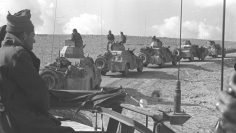


Treblinka and the Trains That Came Back Empty
How do individuals cope with the trauma and loss of their loved ones during the Holocaust, and what does it mean to survive in such inhumane conditions?
Through intimate, first-person testimony, this documentary confronts the Holocaust as lived experience, following Jewish survivors who describe deportation by train, the abrupt tearing away of family, and the moment ordinary life collapsed into a system built for extermination. With treblinka hovering over the story as both a place name and a symbol of what the transports carried toward, the film listens closely to how memory works: fractured, non-linear, and marked by details that refuse to fade. Each voice returns to the same haunting questions—what it meant to endure, what it cost to stay alive, and how anyone could continue after witnessing the disappearance of loved ones.
Structured as a series of interviews woven with historical context and archival material, the narrative moves between ghettos, roundups, and the grim logistics of Nazi oppression. Survivors recount turning points that still feel immediate: the order to leave, the packed railcars, arrival procedures, and the dawning realization that the world they knew had been replaced by systematic cruelty. As accounts reach Auschwitz, the film’s emotional force intensifies, not through spectacle but through the plain, restrained language of those who were there, describing fear, disorientation, and the moral complexity of survival amid enforced dehumanization.
Rather than offering easy closure, the film stays with the aftermath—how trauma persists, how identity is reshaped by loss, and why speaking out matters decades later. The recurring image of trains, and the terrible emptiness of their return, underscores the scale of what was taken, while the act of testimony becomes its own form of resistance. By revisiting treblinka through lived recollection, the documentary insists on remembrance and on the human responsibility to listen—watch and bear witness.
In Nazi-occupied Europe from 1939 to 1945, antisemitic laws, ghettoization, mass deportations, and industrialized murder became state policy under wartime dictatorship. As World War II escalated, rail networks fed a camp system centered on Auschwitz, amid shortages, terror, and the collapse of civil protections.
Knowledge Quiz
Test Your Knowledge
Pick an answer to see whether you got it right — and why.
1 / 8
0 correct so far
This film’s dominant mode is participatory. It is driven by extended, face-to-face interviews where survivors recount events in their own words, shaped by the filmmaker’s questions. This approach makes memory the evidence, centering lived experience to convey trauma’s lasting weight and the moral urgency of remembrance.
Director & Year: Claude Lanzmann, 1985
Holocaust Scope: Nazi Germany and its collaborators murdered approximately six million Jews during World War II (1939–1945), the genocide widely referred to as the Shoah. mk2 Films
Protagonist: Abraham Bomba (Holocaust survivor; Treblinka forced labor), Abraham Bomba (1913–2000) was a barber from Częstochowa who was compelled at Treblinka to cut women’s hair before they were sent to the gas chambers. USHMM Holocaust Encyclopedia
Protagonist: Filip Müller (Auschwitz prisoner; Sonderkommando), Filip Müller (born 1922) was deported to Auschwitz in April 1942 and was assigned to the “Sonderkommando,” forced labor units linked to the killing process in the crematoria. Auschwitz-Prozess Frankfurt
Protagonist: Rudolf Vrba (Auschwitz escapee), Rudolf Vrba and Alfréd Wetzler escaped Auschwitz on April 7, 1944, and produced a report describing the camp’s mass-murder operations, later known as the Vrba–Wetzler report. German History in Documents and Images
Protagonist: Jan Karski (Polish Underground courier), Jan Karski served as a courier for the Polish Underground and Polish government-in-exile, delivering eyewitness information on Nazi-occupied Poland and the persecution of Jews to Allied leaders in 1943. U.S. Congressional Record (GovInfo PDF)
Backstory: Production (1974–1985 filming period), the project was developed over roughly a decade-plus of research and filming across multiple countries before its 1985 release. mk2 Films
Geopolitical Context: (Nazi-occupied Europe, 1939–1945), the events described occurred under German occupation and genocidal policy across Europe during World War II, including deportations by rail to extermination sites such as Auschwitz-Birkenau and Treblinka in occupied Poland. Goethe-Institut Film Database
Topical context
This film is part of the World Map of Conflict dataset—an interactive documentary collection that combines curated films with conflict data and country context to explain geopolitical developments since 1945.
Within the collection, the film sits in the Pax Americana educational pathway, which explores the U.S.-led effort to prevent another global war by promoting, and at times enforcing, liberal democracy and capitalism.
Within that pathway, the film falls under the subtopic Global Responsibility: Fear and Moral Shocks. It explores how the Holocaust, the atomic bombings and the refugee crises left a fear of new catastrophe that drove the postwar push for the UN, war-crimes trials and human-rights law.
This film shows why the Holocaust became the moral shock of the century. It uses no archive images, only witnesses and the places where the killing happened, as they look today. Survivors describe trains that left full and came back empty. A historian explains that only the last step was new: centuries of exclusion ended in murder run like any other state administration. That is the fear the postwar order was built to contain.
Learning Throughlines
Persecution and deportation as a step-by-step machinery, from marking and ghettos to the trains.
The film does not show Jews being made to wear the star or herded into ghettos; instead Raul Hilberg explains that the Nazis took over measures worked out over more than a thousand years, including the marking decrees, especially the Jewish star, and the compulsory ghetto, and that only the final step was new. The deportation itself is told by Abraham Bomba, who recalls the transport from his town leaving around the Jewish holidays, people told they were going somewhere to work although old people and small children were taken, and a sealed wagon rolling east for about 24 hours. Another survivor says her grandparents died in the ghetto within a year of each other. Hilberg on the marking decrees, the Jewish star and the compulsory ghetto 03:02:40
Arrival at the death camps and the shock of industrialised killing.
Rudolf Vrba describes the Auschwitz ramp at night: prisoners woken by the SS, a cordon of guards with guns under the lights, the locked wagons opened and people beaten out of cars where they were packed like sardines, at the end of the line for everybody on the train. Bomba recalls arriving at Treblinka, where men and women were separated under blows, there was no time to think, and then, as if on a command, everything went quiet. Prisoners were then driven to clear away the clothes and bundles in minutes, so that no trace of the previous transport remained. Vrba: the train reaches the ramp, the end of the line 01:39:01
The moral and psychological weight of survival: hope, despair, loss and guilt.
Bomba says that in the ghetto the Jews lived on a dream and a hope that things would be good, and that they believed the story of work because they had no choice. After learning at Treblinka that their families had been gassed, he recalls a night in the barrack when the men could not eat or drink, and in the morning at least four or five, two of them his close friends, had poisoned themselves. Inge Deutschkron, who survived in hiding in Berlin, describes feeling utterly alone and guilty on the day of the great roundup because she had tried to escape a fate the others could not escape. Deutschkron: alone, and guilty that she did not go with them 02:02:59
Testimony as memory-work: bearing witness for remembrance and against denial.
The film is built from witnesses rather than archive images: Vrba says it was hard to comprehend that people could disappear like this and nothing would happen, while each new transport arrived knowing nothing of the last. Deutschkron confronts Berliners who later said they did not know or did not see, pointing out that the roundups went on almost every fortnight for nearly two years. Hilberg explains that he never starts with the big questions but builds a fuller description from details, and that because no single document spelled out the killing, the record has to be pieced together. Deutschkron: they say they didn't see, but they couldn't help seeing it 02:00:50
Related topics
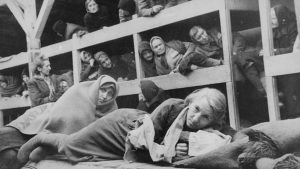

Documentary Mode
This film’s dominant mode is participatory. It is driven by extended, face-to-face interviews where survivors recount events in their own words, shaped by the filmmaker’s questions. This approach makes memory the evidence, centering lived experience to convey trauma’s lasting weight and the moral urgency of remembrance.
Key Facts
Director & Year: Claude Lanzmann, 1985
Holocaust Scope: Nazi Germany and its collaborators murdered approximately six million Jews during World War II (1939–1945), the genocide widely referred to as the Shoah. mk2 Films
Protagonist: Abraham Bomba (Holocaust survivor; Treblinka forced labor), Abraham Bomba (1913–2000) was a barber from Częstochowa who was compelled at Treblinka to cut women’s hair before they were sent to the gas chambers. USHMM Holocaust Encyclopedia
Protagonist: Filip Müller (Auschwitz prisoner; Sonderkommando), Filip Müller (born 1922) was deported to Auschwitz in April 1942 and was assigned to the “Sonderkommando,” forced labor units linked to the killing process in the crematoria. Auschwitz-Prozess Frankfurt
Protagonist: Rudolf Vrba (Auschwitz escapee), Rudolf Vrba and Alfréd Wetzler escaped Auschwitz on April 7, 1944, and produced a report describing the camp’s mass-murder operations, later known as the Vrba–Wetzler report. German History in Documents and Images
Protagonist: Jan Karski (Polish Underground courier), Jan Karski served as a courier for the Polish Underground and Polish government-in-exile, delivering eyewitness information on Nazi-occupied Poland and the persecution of Jews to Allied leaders in 1943. U.S. Congressional Record (GovInfo PDF)
Backstory: Production (1974–1985 filming period), the project was developed over roughly a decade-plus of research and filming across multiple countries before its 1985 release. mk2 Films
Geopolitical Context: (Nazi-occupied Europe, 1939–1945), the events described occurred under German occupation and genocidal policy across Europe during World War II, including deportations by rail to extermination sites such as Auschwitz-Birkenau and Treblinka in occupied Poland. Goethe-Institut Film Database
Related videos
 Watch LaterAdded
 Watch LaterAdded
 Watch LaterAdded
 Watch LaterAdded
 Watch LaterAdded
 Watch LaterAdded